


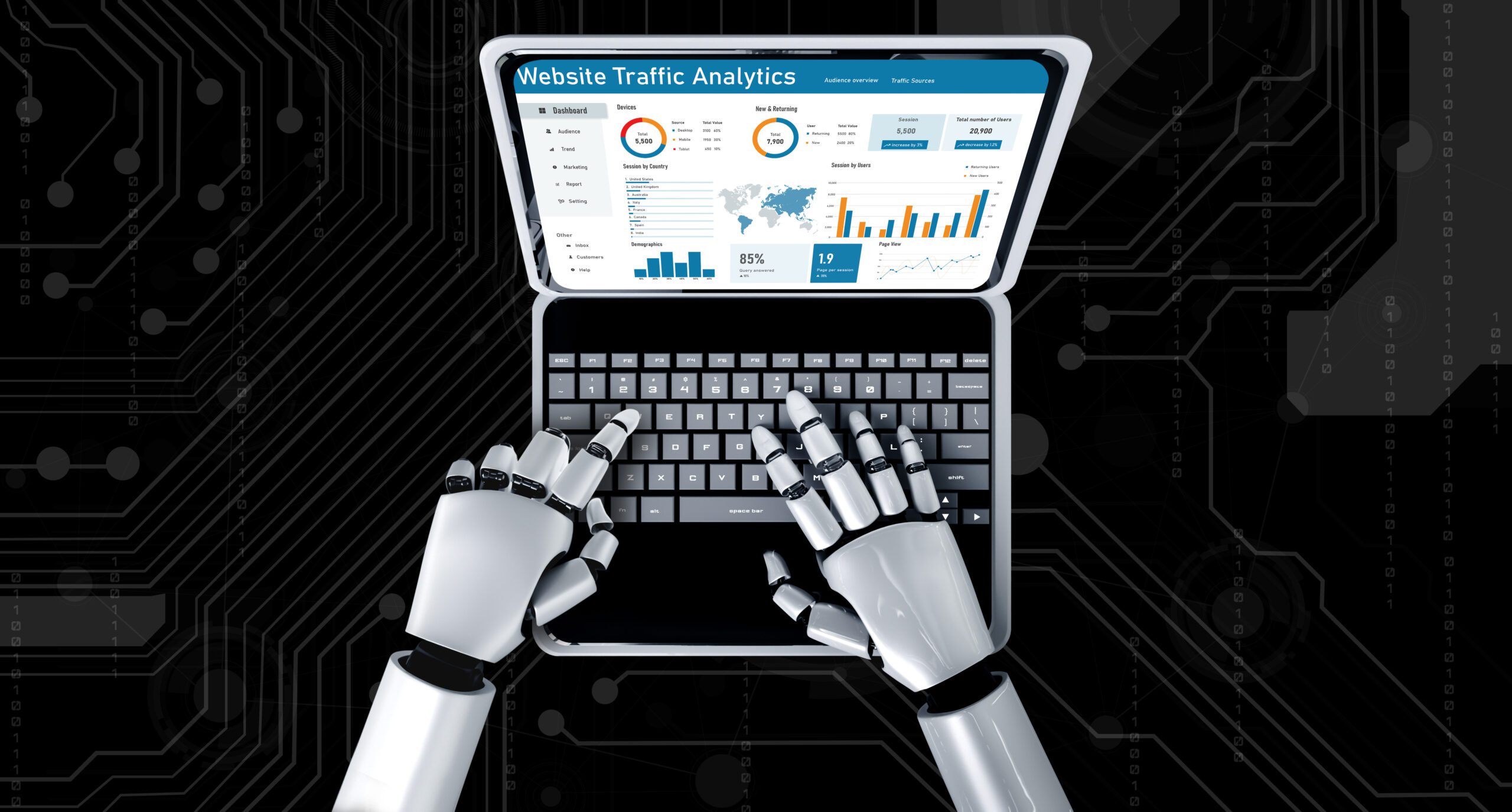
Imagine having a crystal ball for your marketing strategy—one that not only reveals what your customers want today but also predicts their needs tomorrow. That’s the promise of AI-driven marketing analytics. As businesses continue to grapple with an overwhelming amount of data, the ability to extract actionable insights quickly and accurately has become more critical than ever.
The impact of AI on marketing is undeniable. The global AI market, valued at $200 billion in 2023, is projected to surpass $1.8 trillion by 2030. Marketers using AI-powered tools have already reported tangible benefits, including up to a 30% reduction in costs and a 10% increase in revenue through dynamic pricing strategies. These numbers underscore the transformative potential of AI in reshaping marketing analytics and driving measurable results.
In this blog, we’ll explore the cutting-edge trends in AI shaping the future of marketing analytics. From predictive modeling to real-time insights, we’ll unpack how businesses can harness these advancements to stay competitive in a rapidly evolving marketplace. Whether you’re just starting to dip your toes into AI or looking to refine your strategy, this guide will provide the roadmap you need to adapt and thrive.
What is AI in Marketing Analytics?
AI in marketing analytics refers to the use of advanced technologies like machine learning, natural language processing (NLP), and predictive analytics to process and interpret complex data. Unlike traditional analytics, AI doesn’t just describe what happened; it identifies patterns, predicts future outcomes, and even recommends actionable steps.
How is AI Used in Marketing Analytics?
AI powers various facets of marketing analytics, including:
- Data Segmentation: Automatically categorizing customers into highly specific segments based on their behavior and preferences.
- Customer Journey Mapping: Visualizing the entire customer experience to identify touchpoints that drive conversions.
- Sentiment Analysis: Analyzing customer feedback from social media, reviews, and surveys to gauge brand sentiment in real time.
- Digital Ads: Using AI to manage and adjust digital and paid search advertising campaigns dynamically, ensuring the best ROI.
AI-driven marketing analytics offers several key advantages:
- Speed: AI processes vast amounts of data at lightning speed, enabling real-time decision-making.
- Scalability: AI can handle data from multiple sources, making it ideal for businesses with complex marketing ecosystems.
- Personalization: AI tailors marketing messages and offers to individual customer preferences, increasing engagement and loyalty.
By leveraging AI, marketers are no longer limited to analyzing the past—they can proactively shape the future by delivering faster, more honed strategies that align with both customer expectations and business goals.
Emerging Trends in AI-Driven Marketing Analytics
As the technology continues to evolve, several key trends are emerging that highlight its potential to redefine how businesses understand and engage with their customers. Here’s a look at the most impactful advancements in AI-driven marketing analytics:
Predictive Analytics & Forecasting
Predictive analytics is at the forefront of AI’s contribution to marketing. By analyzing historical data, AI models can predict future customer behaviors, sales trends, and market shifts.
- Example: An e-commerce business might use predictive analytics to identify customers likely to make a repeat purchase and target them with personalized discounts.
- Impact: This allows businesses to allocate resources more effectively, focus on high-probability opportunities, and minimize wasted efforts.
Natural Language Processing (NLP)
Natural language processing enables AI to analyze unstructured data—like social media posts, customer reviews, and survey responses—at scale.
- Example: A clothing retailer might use NLP to detect a surge in customer complaints about sizing issues, prompting quick adjustments to product descriptions or manufacturing.
- Impact: Businesses gain a deeper understanding of customer sentiment and emerging trends, helping them address issues proactively and refine their messaging.
Automated Decision-Making
AI’s ability to process data at scale and speed extends to automated decision-making, helping marketers streamline processes and save time.
- Example: Automated bidding strategies in paid search campaigns adjust bids in real time based on performance, ensuring cost efficiency and maximizing ad placements.
- Impact: By automating repetitive tasks, AI frees up marketers to focus on strategy and creativity, while maintaining precision and scalability.
Ethical and Transparent AI Usage
As AI becomes integral to marketing analytics, ethical concerns are gaining prominence. Businesses must ensure transparency, fairness, and compliance with data privacy regulations.
A few years ago, AI-driven marketing analytics sounded like a future-state capability reserved for sophisticated data teams. In 2026, it’s increasingly becoming part of the analytics tools marketers already use.
Google Analytics can summarize important performance changes and let users investigate them conversationally. HubSpot can use AI to review campaigns and report data and answer follow-up questions. Reporting platforms like AgencyAnalytics can bring performance data together, surface notable changes, and generate AI-assisted summaries directly inside the reporting workflow.
That changes the role AI can play in marketing analytics. It’s no longer just about processing more data or predicting what might happen next. AI is making it easier to ask questions of data, find patterns across large datasets, investigate performance changes, and move from information toward a decision.
But easier access to analysis doesn’t automatically mean better decision-making. AI can accelerate the work. It can surface things humans might miss. It can also confidently draw the wrong conclusion from incomplete data, flawed assumptions, or missing business context.
The real opportunity for marketers isn’t handing analytics over to AI. It’s using AI to shorten the distance between data, understanding, and action without outsourcing the judgment required to know whether the answer actually makes sense.
Let’s look at how AI in marketing analytics has evolved, the capabilities that matter now, and how businesses can use them without confusing faster analysis with better strategy.
What is AI in Marketing Analytics?
AI in marketing analytics refers to the use of machine learning, generative AI, natural language processing, predictive models, and increasingly AI agents to analyze marketing and business data.
Traditional analytics largely required users to know where to look, what report to build, and which questions to ask. AI is changing that interaction. Depending on the platform, marketers can now ask questions in natural language, automatically surface unusual performance changes, summarize complex datasets, identify patterns, forecast outcomes, and receive recommended next steps.
That doesn’t eliminate traditional analytics. It adds a new layer on top of it designed to make large or complex datasets easier to interrogate and interpret.
How is AI Used in Marketing Analytics?
AI now supports several parts of the analytics process, including:
- Performance Analysis: Identifying important changes, anomalies, correlations, and patterns across campaign or customer data.
- Conversational Analytics: Allowing marketers to ask questions about their data in plain English rather than manually building every report or query.
- Predictive Analytics: Forecasting outcomes such as purchase likelihood, churn, revenue, demand, or campaign performance based on historical patterns.
- Customer and Audience Analysis: Identifying meaningful segments, behaviors, preferences, and common characteristics across large datasets.
- Qualitative Analysis: Synthesizing customer interviews, reviews, surveys, social conversations, and other unstructured information to identify recurring themes and sentiment.
- Campaign Optimization: Helping marketers understand what is and isn’t performing and, in some platforms, recommending or executing adjustments.
- Cross-Source Synthesis: Bringing together data from different systems or files to help teams answer business questions that don’t live neatly inside a single dashboard.
The biggest advantage may not be that AI produces entirely new types of analysis. It’s that sophisticated analysis is becoming dramatically more accessible. Marketers can move more quickly from “something changed” to “here are the likely reasons why.” However, speed should not be confused with certainty. AI-generated findings still need to be evaluated against the underlying data, business context, and what the organization actually knows to be true.
Emerging Trends in AI-Driven Marketing Analytics
Conversational Analytics Is Becoming the New Interface
For years, getting an answer from marketing data often meant navigating dashboards, creating filters, exporting spreadsheets, or asking an analyst to build another report. Increasingly, marketers can simply ask. Natural-language analytics allows users to pose questions such as:
- “What caused our conversion rate to fall last month?”
- “Which campaigns contributed most to pipeline growth?”
- “How has customer acquisition changed by segment?”
The technology can then analyze the available data, surface relevant metrics, visualize findings, and support follow-up questions. This makes analytics more accessible to people who aren’t data specialists. It also raises an important new challenge: knowing how to ask a good question—and recognizing when the answer requires deeper investigation.
AI Is Moving From Insight to Action
One of the biggest changes since the first wave of generative AI is the rise of AI agents.
Instead of responding to a single prompt, agentic systems can complete multiple steps toward an objective: finding relevant information, analyzing it, identifying a potential issue, recommending an action, and in some environments initiating the next step.
For marketing analytics, this could mean systems that continuously monitor campaign performance, investigate significant changes, generate a summary, recommend an adjustment, or trigger an approved workflow.
That can dramatically reduce manual work. It also makes governance more important. The closer AI gets to acting on an insight rather than simply presenting one, the clearer organizations need to be about where human review and approval belong.
Predictive Analytics Is Becoming Table Stakes
Predictive analytics isn’t new anymore, but its availability is expanding. Platforms can use historical behavioral data to estimate outcomes such as purchase probability, churn risk, expected revenue, or campaign performance. What once required specialized data science expertise is increasingly built into mainstream marketing and analytics platforms. The strategic advantage is knowing which predictions matter, whether the underlying data is strong enough to trust them, and what decisions should change as a result.
AI Is Making Unstructured Data Much More Useful
Some of the richest marketing information has historically been the hardest to analyze: customer interviews, survey responses, sales notes, reviews, support conversations, social posts, and open-ended feedback. Generative AI can process this material at a scale that would be extremely time-consuming manually, helping teams identify recurring themes, objections, sentiment, customer language, and emerging issues.
This creates enormous opportunities for Voice of Customer and Market Research. It also makes source validation essential. AI is excellent at synthesizing patterns, but it should not be allowed to turn weak evidence into a strong conclusion.
Data Quality and Governance Matter More, Not Less
AI does not fix bad data.If your attribution is unreliable, CRM data is incomplete, definitions vary across departments, or critical business context lives outside the system, AI may simply produce a faster and more persuasive interpretation of a flawed picture. Organizations adopting AI-driven analytics therefore need clear standards around:
- Which data AI can access
- How metrics are defined
- How sensitive information is handled
- Which outputs require human validation
- How AI-generated conclusions are checked against source data
- Which decisions AI can recommend versus execute
As AI becomes easier to use, the competitive advantage shifts from simply having the technology to having the judgment and discipline to use it well.
Key AI Tools Shaping Marketing Analytics
AI capabilities are now being embedded into many of the platforms businesses already use rather than existing only as standalone tools. Here are several worth watching:
- Google Analytics: In addition to predictive metrics such as purchase probability, churn probability, and predicted revenue, Google is introducing increasingly conversational and agentic analytics capabilities. AI Overviews can surface important changes in performance, while Ask Advisor allows users to investigate questions about their marketing data using natural language.
- HubSpot Breeze: Breeze Assistant can summarize and analyze CRM, campaign, email, and reporting data and allow marketers to ask follow-up questions about performance. That makes AI analysis available directly inside the system where much of a company’s marketing and customer data already lives.
- Salesforce Agentforce Marketing (formerly Marketing Cloud): Salesforce continues to embed predictive and generative AI throughout its marketing platform, including segmentation, optimization, campaign creation, and agent-supported workflows.
- AgencyAnalytics: This reporting platform connects data from 85+ marketing platforms in one place. Its Ask AI and AI Summary features can answer questions about performance, surface trends and anomalies, and generate editable report summaries. We use it at &Marketing to consolidate reporting, but its AI-generated explanations still need context and review before they become recommendations.
- Hootsuite Listening powered by Talkwalker: Hootsuite’s current listening platform uses AI to analyze online conversations, identify patterns and sentiment, monitor emerging narratives, and surface insights across social and other digital sources.
General-purpose AI platforms are also becoming much more useful for analytics. Tools such as ChatGPT, Claude, and Gemini can help teams analyze files, synthesize qualitative research, interrogate datasets, identify patterns, and develop hypotheses—depending on the tool, plan, connected data sources, and security settings available.
The important question is no longer simply, “Which AI tool should we buy?” It’s: What decision are we trying to make, what information is required to make it, and which technology can help us get to a credible answer faster?
How to Choose the Right AI Tool for Your Business
Selecting the right AI tool can seem overwhelming, but focusing on your specific needs and objectives will make the process more manageable. Here are some key criteria to consider:
- Ease of Integration: Look for tools that integrate seamlessly with your existing tech stack, such as CRMs, CMSs, and data lakes.
- Scalability: Ensure the tool can grow with your business, accommodating increasing data volumes and complexity.
- Data Privacy Compliance: Verify that the tool adheres to relevant data privacy laws, such as GDPR or CCPA, to maintain customer trust.
- Customization Options: Choose tools that allow for tailored insights and workflows specific to your industry or business model.
- User Experience: Select platforms with intuitive dashboards and visualizations to make data analysis accessible to your team.
- Traceability and Validation: Look for tools that make it possible to understand where an answer came from, inspect the underlying data, and validate important conclusions. A polished AI-generated explanation is not useful if no one can determine whether it is correct.
The right AI tool is a critical component of a successful marketing strategy. The ideal solution will empower your team to make data-driven decisions, uncover opportunities, and streamline operations. Businesses that invest in the right tools today will position themselves to leverage the full potential of AI in marketing analytics tomorrow. By equipping yourself with the right technology, you can transform raw data into meaningful insights that drive growth and innovation.
How Businesses Can Adapt to AI-Driven Analytics
Adopting AI-driven marketing analytics no longer requires a massive AI transformation project. In many organizations, the technology is already appearing inside the platforms teams use every day. The harder question is how to use it responsibly and productively.
1. Start With the Business Question
Don’t begin with, “How can we use AI?” Begin with the decision you’re struggling to make.
Why did the pipeline decline? Which customer segment represents the strongest opportunity? Are we actually gaining ground against competitors? Which marketing investments are contributing to growth?
AI becomes much more useful when it is applied to a specific question rather than deployed because the organization feels like it should be “doing AI.”
2. Get Your Data in Order
AI thrives on high-quality data and can become dangerously convincing when the underlying data is poor. Before relying heavily on AI-generated analysis, make sure important metrics are defined consistently, data sources are reasonably complete, and teams understand known gaps and limitations.
3. Give AI More Context, Not More Authority
One of the biggest improvements in modern AI analytics comes from giving systems access to more relevant business context: performance data, customer information, research, historical decisions, and other approved sources. That can produce significantly better analysis. It should not mean allowing the system to make high-stakes decisions without review. Use AI to generate hypotheses, identify patterns, accelerate analysis, and challenge assumptions. Keep human judgment involved when deciding what those findings mean for the business.
4. Build Validation Into the Process
Treat important AI-generated findings the same way you would treat any other analytical conclusion. Check the source data. Look for competing explanations. Ask what information is missing. Determine whether correlation is being mistaken for causation. Pressure-test recommendations against what you know about the market and business. AI makes analysis faster. Good analytical discipline determines whether that speed actually produces better decisions.
5. Establish Clear Governance
Organizations should define what information can be shared with AI systems, which platforms are approved, how sensitive data is handled, and which workflows require human oversight.
As AI moves from answering questions toward taking action, these guardrails become increasingly important.
The future of marketing analytics isn’t really about AI replacing analysts, marketers, or business leaders. It’s about dramatically reducing the friction between having data and understanding what that data means.
That is a meaningful shift. Teams can investigate more questions, analyze larger volumes of information, identify patterns faster, and spend less time manually assembling reports. AI cannot compensate for weak data, vague business questions, or poor judgment. In fact, it can make all three harder to spot by producing answers that sound remarkably convincing.
The companies that get the most value from AI-driven analytics won’t necessarily be the ones with the most tools. They’ll be the ones that combine better technology with strong data, useful questions, external context, and experienced human judgment. Getting an answer faster is useful, but knowing whether it’s the right answer is what actually matters.
If your organization has plenty of marketing data but still struggles to understand what’s happening, why it’s happening, or what to do next, that’s where outside analysis can help. &Marketing combines internal data with market, customer, competitive, and performance insight to give leadership a clearer picture of what’s actually going on.
Let’s Connect!
"*" indicates required fields